What it is
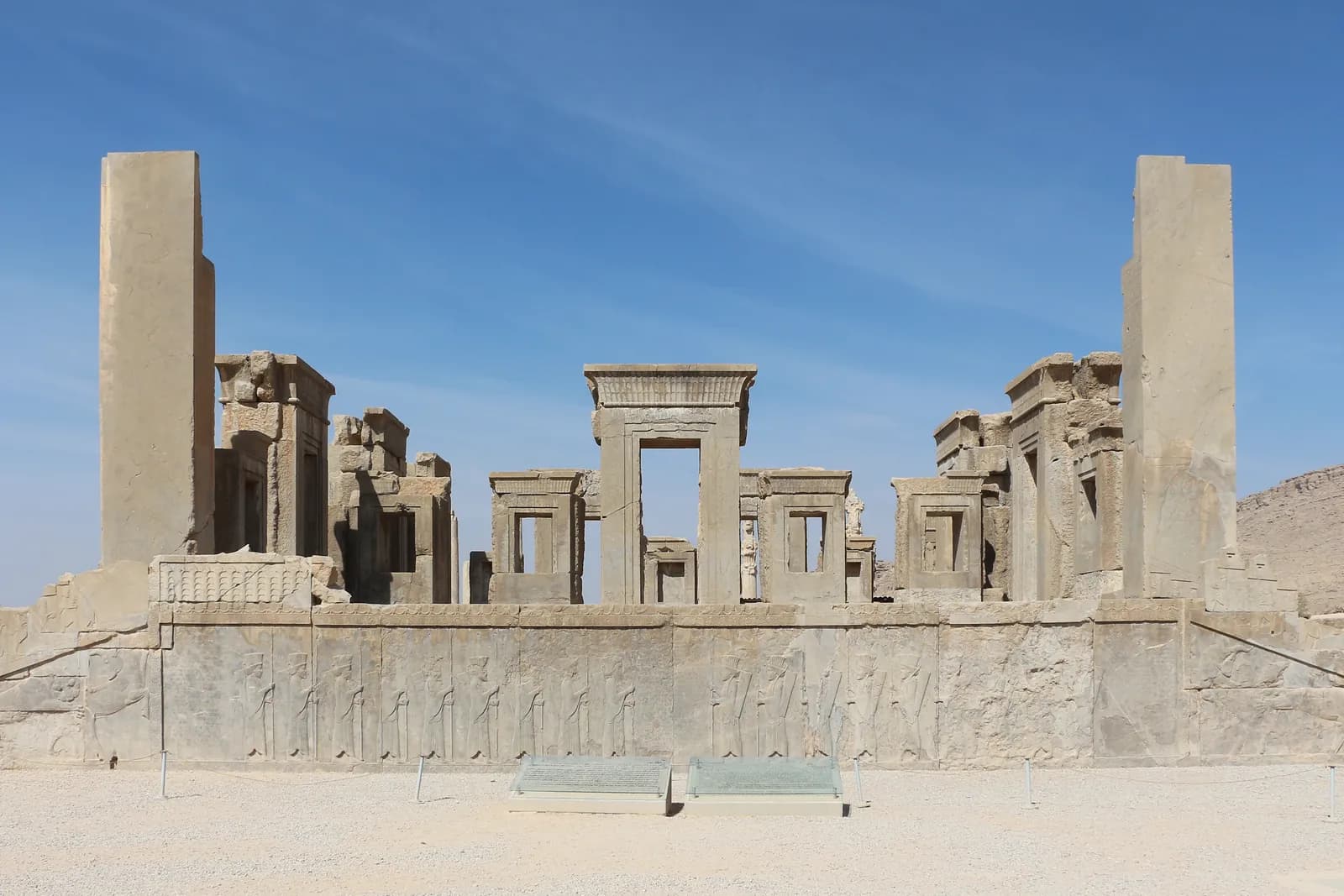
The Tachara — Darius's own palace, completed by Xerxes, its polished stone doorframes and reliefs, and the later inscriptions cut on it by Sasanian and Islamic visitors.
Built Begun under Darius I and completed under Xerxes I. The principal date, begun under Darius I, before 486 BCE, is approximate.
before 486 BCE
Darius's building
Darius's inscriptions on the building call it his tachara — a word usually rendered palace — and name him as its builder.
after 486 BCE
Completion under Xerxes
Xerxes' inscription records that he completed what his father had begun. Both texts are on the building.
Sasanian and Islamic periods
Later inscriptions
Middle Persian and Arabic and Persian inscriptions were cut on the doorframes by later visitors, including a Buyid ruler's record of a visit in the tenth century. They are part of the monument.
Who ordered it built
Each attribution carries what supports it. Ancient buildings are routinely credited to people on the authority of writers centuries later, and that is not the same claim as an inscription on the building.
- Evidence level: Documented
Commissioned by
Darius I
His own inscriptions on the building, in Old Persian, Elamite and Babylonian.
- Evidence level: Documented
Completed by
Xerxes I
His inscription on the same building recording its completion.
What it was for
A residential palace on the terrace, small by comparison with the Apadana: a columned hall with subsidiary rooms, a portico facing south, and a stair with reliefs.
The word tachara is Darius's own for the building and its meaning is not precisely established beyond palace or residence. What the rooms were used for is not recorded.
How it was built
The building's survival is a lesson in what fire does. Its walls were mudbrick and its roof timber, and both are gone; the stone doorframes, window frames and wall niches were monolithic and stayed standing, so the palace reads today as a grid of freestanding stone frames.
The polish on that stone is exceptional and is original. It was achieved by abrasive finishing after setting, and it is the best surviving evidence for the quality of Achaemenid stone-finishing.
The doorjamb reliefs show the king leaving the room, attended by servants with a parasol and a fly-whisk — a repeated composition that appears throughout the terrace and treats the king as a fixed type rather than a portrait.
Materials
- Evidence level: Documented
Dark grey limestone, polished
The doorframes, window frames and niches, finished to a mirror surface that survives
- Evidence level: Documented
Mudbrick
The walls between the stone frames, now gone
Measured
Every figure states what it rests on. A modern survey, an ancient text, a conversion from an ancient unit and a modern estimate are four different kinds of statement and are not interchangeable.
The main hall
about 15.2 × 15.2 m, with twelve columns
Modern survey of the column bases and doorframes.
Doorframes and windows
standing to full height, about 4 m
Direct measurement of the standing frames.
What it meant
That Darius built his own residence on the terrace and that Xerxes finished it and said so is the pattern of the whole complex: an inherited project, with each king recording his part. Achaemenid royal inscriptions are consistently concerned with continuity and with naming a father.
The later inscriptions on the doorframes turn the building into a visitors' book spanning fifteen centuries. Sasanian and Islamic-era rulers came to Persepolis, understood it as royal, and recorded themselves on it — which is a piece of evidence about how the Achaemenid past was regarded long after the Achaemenids were forgotten as a dynasty.
After antiquity
Burned in 330 BCE, less severely than the halls with more timber in them. Standing thereafter and repeatedly visited and inscribed.
Excavated and consolidated in the 1930s by Herzfeld and Schmidt.
Condition today
Standing ruin
The stone frames stand complete with their reliefs and their polish; the walls and roof are gone. It is the most legible building on the terrace.
The building's stone elements were largely in place at excavation, which allowed the plan and the elevation of the frames to be established without reconstruction.
Traces of the mudbrick walls between the frames were recorded, establishing that the stone elements were set into brick rather than forming a stone building.
Scattered fragments
What has left the building, and where it is now. Where a holding is contested, the museum page says so.
- Evidence level: Documented
Relief fragments removed in the nineteenth century
Written about in antiquity
Darius I and Xerxes I, The palace inscriptions DPa, XPc
Darius naming the building as his, and Xerxes recording its completion. Both cut on the building itself, in three languages.
Arrian, Anabasis of Alexander 3.18
Arrian on the taking and burning of the palaces at Persepolis.
Still argued
What does tachara mean?
The Old Persian word is used of this building and of others, and is translated as palace, residence or winter palace. The last rests on an etymology that is not secure. What the building was used for, and whether it was a dwelling in any ordinary sense, is not established.
How to read the evidence labels
- Evidence level: Documented
- Supported by a named primary text or by excavated material evidence.
- Evidence level: Probable
- Supported by strong inference that most specialists accept.
- Evidence level: Disputed
- Substantial specialist disagreement exists; competing readings are stated.
- Evidence level: Literary
- Belongs to poetic or mythological construction rather than to history.
- Evidence level: Mythological
- Belongs to shared religious or mythic tradition rather than to any single text.
- Evidence level: Unknown
- The available evidence is insufficient to decide.
These labels describe the status of the evidence, not our confidence in a conclusion. A claim marked Literary is not a claim we doubt; it is a claim about what kind of thing a poem is.